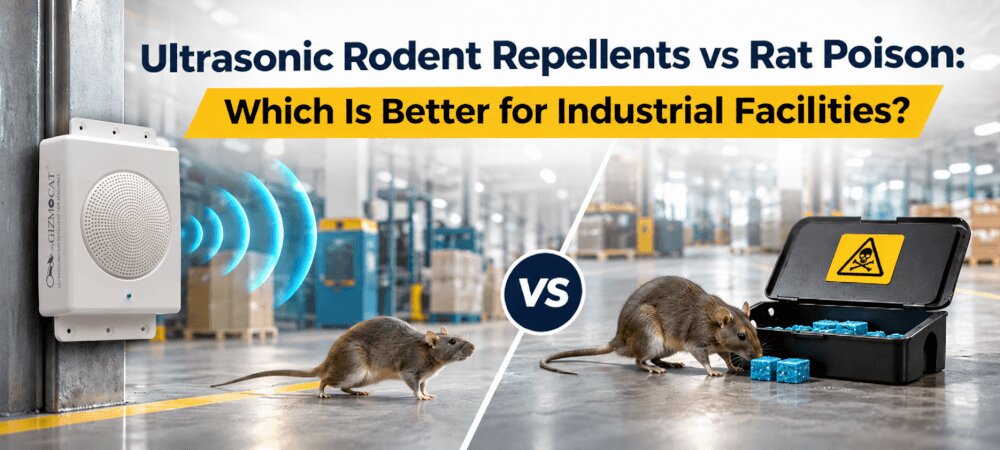
Ultrasonic Rodent Repellents vs Rat Poison: Which Is Better for Industrial Facilities?
Rats and mice are more than just a nuisance in industrial facilities. They can damage electrical wiring, machinery, stored goods, packaging materials and important infrastructure. In factories, warehouses and manufacturing units, rodent activity can lead to financial losses, operational disruptions and hygiene concerns.
For decades, rat poison has been one of the most commonly used solutions for controlling rodents. However, there is a serious concern that often goes unnoticed: the impact of rodenticides on the environment and wildlife.
Today, businesses are exploring alternatives such as ultrasonic rodent repellents that aim to discourage rodents without using poisonous chemicals.
So, which is better for industrial facilities: traditional rat poison or ultrasonic rodent repellents? Let's compare both.
1. Rat Poison: A Traditional Approach to Rodent Control
Rat poison, also known as rodenticide, is designed to kill rats and mice after ingestion. It is commonly used in factories, warehouses, storage facilities and commercial premises.
Advantages of Rat Poison:
- Can help reduce an existing rodent population when used correctly.
- Different formulations are available for different infestation situations.
- Can be useful for controlling rodents in certain environments.
However, rat poison comes with several limitations that industries should consider.
The Hidden Risks of Rat Poison:
- Secondary poisoning: When birds of prey, owls, snakes, cats or other animals consume poisoned rodents, they can also become exposed to toxic substances.
- Environmental impact: Rodenticides can enter the food chain and affect non-target wildlife.
- Dead rodents: Rats may die inside machinery, false ceilings, walls or inaccessible spaces, creating unpleasant odours and hygiene concerns.
- Chemical safety: Accidental exposure can pose risks to employees, pets and other non-target animals.
- Recurring expenses: Bait stations require regular inspection, replenishment and monitoring.
Most importantly, rat poison does not prevent new rodents from entering a facility. It only targets rodents that consume the bait.
2. Ultrasonic Rodent Repellents: A Chemical-Free Alternative
What if you could discourage rodents without killing them or introducing poisonous substances into the environment?
Ultrasonic rodent repellents use high-frequency sound waves designed to make the surrounding environment uncomfortable for rats and mice.
Unlike rat poison, these devices do not aim to kill rodents. Instead, they are designed to discourage rodent activity in the protected area.
Industrial ultrasonic rodent repellents can be installed in factories, warehouses, manufacturing units, storage areas and other suitable indoor environments.
Advantages of Ultrasonic Rodent Repellents:
- Chemical-free operation: No poisonous bait or toxic chemicals are required.
- Continuous operation: Devices can operate 24×7 when properly installed and powered.
- No secondary poisoning from bait: Since no poisonous bait is involved, there is no poisoned rodent carcass created by the device.
- No dead rodents: The technology does not kill rodents, avoiding carcass-related problems caused by poisoning.
- Low maintenance: No bait replacement or chemical replenishment is required.
- Industrial suitability: Can be used in appropriate indoor environments as part of a preventive rodent management strategy.
Are There Any Limitations?
Ultrasonic technology is not a magic solution. Its effectiveness can vary depending on the device, installation, room layout and infestation conditions. Sound waves may not effectively penetrate walls, closed compartments or obstacles. Rodents may also become accustomed to repeated sound exposure.
Therefore, devices should be selected carefully and installed according to the manufacturer's recommendations.
3. Ultrasonic Rodent Repellents vs Rat Poison: A Quick Comparison
| Comparison | Rat Poison | Ultrasonic Repellent |
|---|---|---|
| Working principle | Kills rodents through ingestion | Uses high-frequency sound |
| Chemical usage | Yes | No |
| Kills rodents | Yes | No |
| Secondary poisoning risk from the method | Possible | No poisoned bait involved |
| Dead rodents | Possible | Does not kill rodents |
| Continuous operation | Requires bait monitoring | Can operate 24×7 |
| Maintenance | Bait inspection and replenishment | Periodic device inspection |
| Environmental concerns | Potential food-chain contamination | No rodenticide chemicals |
| Primary purpose | Population control | Deterrence and discouraging activity |
4. Which Is Better for Factories and Warehouses?
For industrial facilities, rodent management should go beyond simply killing rats. Businesses must also consider employee safety, environmental responsibility and long-term prevention.
Rat poison may reduce an existing rodent population, but the risk of secondary poisoning makes it an important environmental consideration.
An owl consuming a poisoned rat, a snake eating an affected rodent or another predator feeding on poisoned prey can become an unintended victim of rodent control.
Ultrasonic rodent repellents offer a different approach. Instead of introducing toxic substances into the environment, they use sound-based technology to discourage rodent activity.
For facilities looking to reduce dependence on chemical rodenticides, ultrasonic devices can be a useful part of a preventive rodent management strategy.
Good housekeeping, proper waste disposal, secure storage of materials and sealing potential entry points should also be part of an effective rodent prevention programme.
5. Why Consider GIZMOCAT Industrial Ultrasonic Rodent Repellents?
For businesses looking to move away from traditional poison-based rodent control, GIZMOCAT® offers an industrial ultrasonic rodent repellent solution.
Designed for commercial and industrial environments, GIZMOCAT provides:
- 100% Chemical-Free: No poisonous bait or toxic chemicals.
- Safe for Humans and Pets: Designed for use around people and pets when installed as directed.
- 24×7 Continuous Protection: Operates continuously to discourage rodent activity.
- Maintenance-Free: No bait replacement or chemical replenishment.
- Easy Installation: Suitable for various industrial and commercial environments.
- Silent and Non-Intrusive: Does not disturb regular workplace activities.
- Approx. 300 sq. ft. Coverage: Per unit in enclosed areas, depending on site conditions.
GIZMOCAT gives businesses an opportunity to adopt a preventive, chemical-free approach to rodent management without depending entirely on poisonous baits.
Explore industrial rodent protection solutions at https://gizmocat.in/
Final Verdict: Protect Your Facility Without Poisoning the Food Chain
Rat poison has traditionally been used to control rodents, but its impact can extend far beyond the targeted rat. Secondary poisoning, environmental contamination and dead rodents in inaccessible spaces are important concerns for industrial facilities.
Ultrasonic rodent repellents offer a different approach: continuous, chemical-free deterrence without killing rodents or introducing rodenticides into the food chain.
For factories, warehouses and manufacturing facilities, choosing a rodent management solution should not be just about eliminating rats. It should also be about protecting employees, surrounding wildlife and the environment.
Don't just control rats. Protect your facility without poisoning the ecosystem.
Choose a smarter, chemical-free approach to industrial rodent protection with GIZMOCAT®.

